
ONE CREED. ONE CHRIST. ONE CALLING.
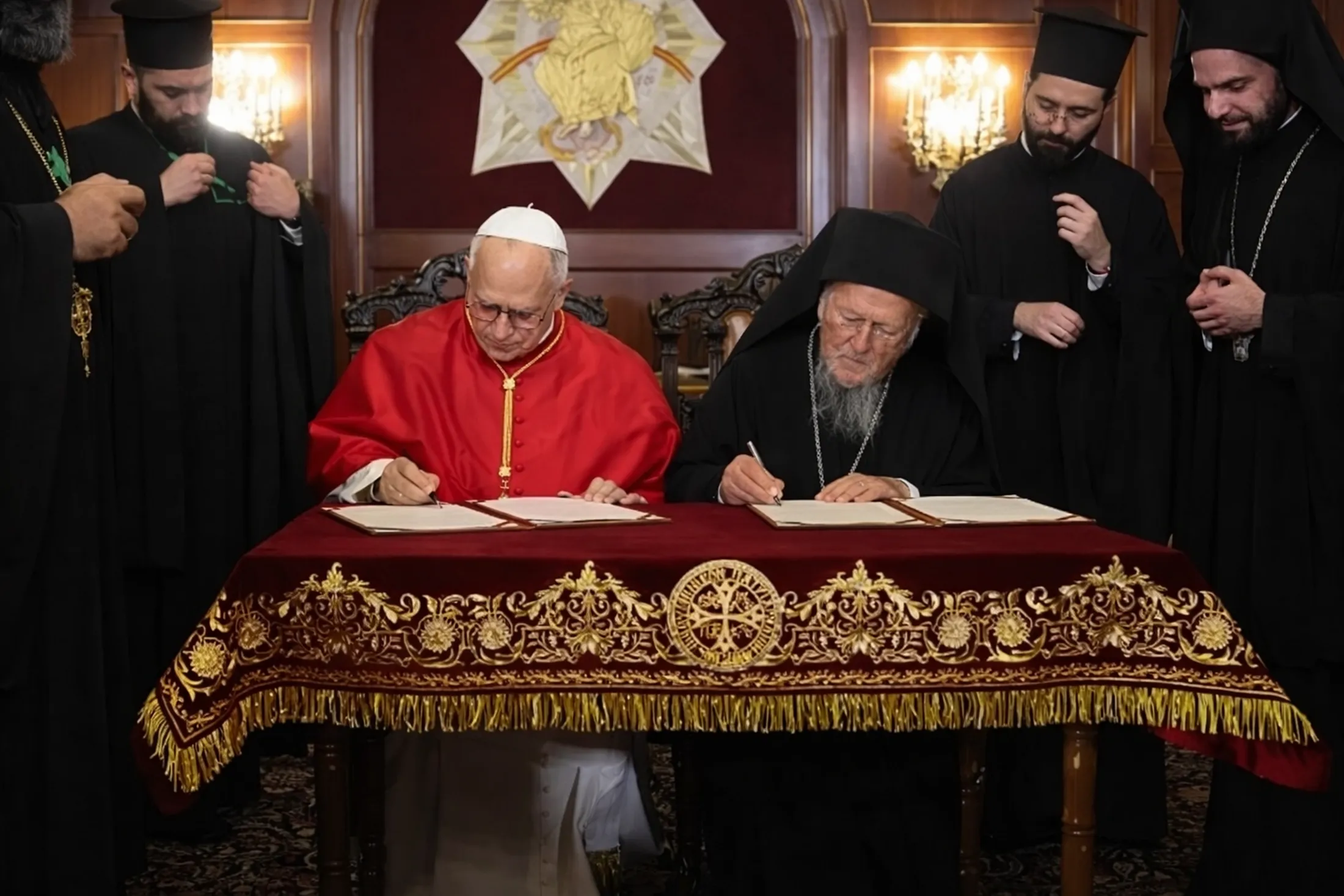
As The Knights of Malta Club, we find ourselves witnesses to an extraordinary moment in the life of the Church. In Nicaea—the very place where the first Ecumenical Council defined the Creed that still unites Christians across centuries—Pope Leo XIV and Ecumenical Patriarch Bartholomew I stood together, prayed together, and offered a joint blessing. It was not merely an act of courtesy. It was a return to origins, a reminder that the story of Christianity began not in division, but in common proclamation.
Nicaea remains more than a chapter in history; it is a point of reference for what Christians once shared without hesitation: a unified confession of faith, spoken with conviction and received without fracture. The blessing given there in our own time invites us to recall that Christianity is not an archipelago of isolated traditions, but a continent shaped by the same Gospel. The gestures of the Pope and Patriarch echoed across time, suggesting that the Church, long accustomed to separation, has begun once more to breathe with both lungs.
Our Club draws its identity from the honourable lineage of Christian knighthood. The knights of old did not exist for pomp or privilege; they served Christ, defended the vulnerable, and sought harmony among believers. In our own age, the battlefield has changed, yet the calling remains. Whether one is Catholic, Orthodox, Anglican, or Protestant, the knightly spirit is not confined to one tradition. It stands where truth is upheld, where faith is lived with dignity, and where brothers and sisters in Christ recognise one another without suspicion.
To speak of unity today is not to demand sameness. Rather, it is to remember what precedes every difference: Christ Himself. Before liturgy, before polity, before dogma sharpened into dispute, there was an encounter with the risen Lord. A modern knight does not wield steel against fellow Christians, but wields fidelity against forgetfulness. He guards not territories, but meanings; not fortresses, but the memory of an undivided Church.
That memory is not mere sentiment. It is the grammar of Christian identity, the syntax of a faith that once spoke one language before it learned to quarrel in dialects. Nicaea stands as the punctuation mark where unity was inscribed into doctrine; its echo now challenges us to read our history not as a record of estrangement, but as a text awaiting reconciliation.
If leaders of ancient Churches can meet again where the Creed was born, then the rest of us, heirs of that same Creed and bearers of this knightly vocation, cannot pretend that division is destiny. We are called not to replicate the past, but to live what it taught: that truth is strongest when shared, and that the Church fulfils her mission not when she speaks many tongues, but when she speaks with one heart.
In such moments, history ceases to be a museum of relics and becomes a living manuscript in which new lines are written. And it is there, between the words of faith and the deeds of those who uphold it, that the prayer first spoken in the Upper Room continues to resonate with quiet insistence:
“May they all be one!”